The size of your pond is important when it comes to pond management. The size of your pond is the major factor that will determine what fish species to stock, the degree of management needed to maintain these fish, and how many fish you can remove each year. In short, it is important that you properly calculate pond size before you do anything! Many farm ponds are also built for livestock watering and are less than 1 acre in surface area, but many small ponds are built for purely recreational purposes too.
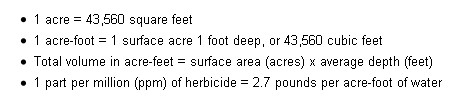
When it comes to estimating pond or lake size, it’s not important why the pond was constructed, but only that you calculate the pond’s size accurately. Many pond owners of small ponds want bass, but small ponds not suited for bass populations. This is primarily because bass harvest management in small ponds is especially difficult and unrewarding, as nearly all bass caught must be released to prevent overpopulation by forage fish.
In small ponds, it is usually better to stock only catfish since they provide more fishing recreation, food for the table, and can be fed commercially prepared feed. Ponds larger than 1 surface acre are more suitable for multiple fish species. If these larger ponds undergo proper fish stocking, are managed and harvested properly, then you can expect many years of satisfactory fishing for all sport species, including largemouth bass. Of course, the pond could still be managed for producing quality catfish. The choice is yours, but only if the size of your pond is adequate.
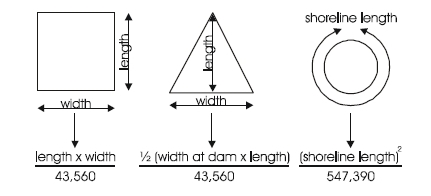
Many pond owners have difficulty estimating the surface area of their ponds. In fact, it is easy to overestimate pond size, but this is not a good thing. An overestimate of size often leads to overstocking of fish. If your pond fluctuates considerably in surface area, make sure to stock it based on the average annual low water surface area. This is more conservative, but a realistic approach for pond management purposes. Remember that 1 surface acre contains 43,560 square feet. Formulas for calculating the surface area in acres of the most common pond shapes—square or rectangular, triangular, and round—are provided above to assist you in determining the size of your pond. Make sure all dimensions are measured in feet. Good luck estimating the size of your pond!